



July 2025 Issue

A MESSAGE FROM THE PUBLISHER
What’s Next in Perimeter Security?
This month, we asked: “What significant changes do you predict in perimeter safety and security in the coming year?”
Mike Keegan, Vice President at Magnasphere, offered a sobering but clear-eyed response:
“Threats to business, critical infrastructure, and data will only increase and grow more sophisticated. The instability of global politics will accelerate efforts by adversarial nations to disrupt U.S. commerce. Our defense depends on heightened awareness, constant vigilance, and adopting the most advanced security technologies available.”
The Story Behind Marriott’s Safer Hotel Design
Why are the room doors and sliding glass doors at Courtyard by Marriott hotels on the inside, facing a secured courtyard?
The answer goes back to a tragedy that helped shape modern hotel security standards.
On July 16, 2025, singer Connie Francis passed away at 87. Known for hits like “Who’s Sorry Now” and her appearances on The Ed Sullivan Show, Francis saw a resurgence in popularity when her song “Pretty Little Baby” became a viral TikTok hit decades later.
But she also made history for another, heartbreaking reason.
In 1974, Francis was assaulted in her hotel room after an intruder broke in through a sliding door. At the time, no hotel or third party had ever been held financially liable for a crime committed by someone else. But Francis sued Howard Johnson’s for negligence—and won a landmark $2.5 million verdict (equivalent to more than $19 million today).
That case permanently changed hotel security expectations. It also led Marriott to hire Chad Callaghan, who helped design the Courtyard brand with guest safety in mind: one main lobby entrance, interior-facing room doors, and secure courtyards.
That legacy lives on in every Courtyard property today.
Read more about this on LinkedIn.
What’s Inside This Issue?
Welcome to our third issue of Smart Perimeter. This month, we take on the biggest, thorniest challenges in perimeter safety—issues that remain unresolved due to cost, politics, or sheer complexity:
- Drone defense
- Organized retail crime
- Pedestrian safety in public spaces
- A surprising lack of interest in perimeter security from today’s reseller channel
We want to hear your ideas on what’s working, what’s not, and how we can make the perimeter safer and more resilient. Reach us at info@smartperimeter.ai to get the conversation started.
Thanks for reading,
Mark McCourt
SMART PERIMETER JULY RETAIL CRIME FEATURE
Outdoor Asset Crime is Rampant. Retailers Can Stop It.
Retail crime is often associated with shoplifting and employee theft. According to the National Retail Federation’s 2023 National Retail Security Survey, employee (internal) theft accounted for 29% of total retail shrinkage in FY 2022, while theft overall (internal + external) represented roughly 65% of all losses. These losses are typically handled by loss prevention teams.
But outdoor asset crime is different, and in many cases, more damaging.
Outdoor asset crime refers to theft, destruction, or intrusion that targets inventory stored outside store walls. This includes goods for rent or sale to the public, such as RVs, trailers, heavy equipment, or generators. In these cases, businesses are not just at risk of financial loss. They’re also exposed to facility damage, infrastructure outages, trespassing liability, and even personal injury lawsuits.
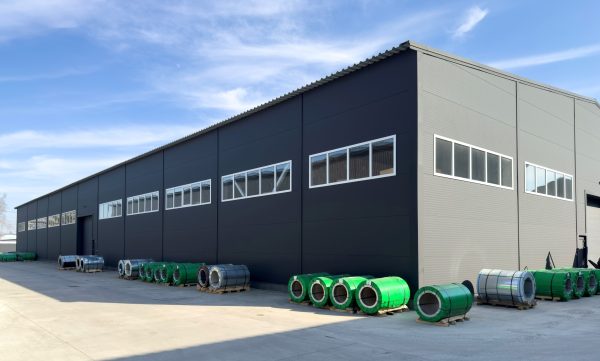
For example:
- A retail RV dealer lot might be targeted for high-dollar vehicles or parts.
- A building supply store’s yard could suffer copper theft from HVAC systems.
- A rental company’s fenced yard may face break-ins that result in stolen UTVs or vandalized equipment.
These incidents often happen after hours, with no staff present, and fall well outside the domain of traditional retail loss prevention. Preventing them requires a perimeter-focused strategy, including fencing, detection, lighting, and remote response, which is specifically designed to stop intrusions before they escalate into theft, damage, or liability.
Key distinction:
- Retail crime refers to internal threats like shoplifting or employee theft and is addressed by loss prevention teams.
- Outdoor asset crime involves external threats—often after hours—and requires a perimeter security strategy to physically secure the property and reduce exposure.
Outdoor Asset Crimes: The Risk Is Real and Expensive
Whether it’s an RV dealership, equipment rental yard, or building supply lot, outdoor inventory is a sitting target. Thieves are not just stealing goods, they are triggering a ripple effect of operational and financial consequences.
- Direct Losses: Stolen welders, generators, and UTVs can cost $10,000 to $30,000 or more (Amarok).
- Operational Disruption: Power outages, HVAC damage, or breached fences can shut down business temporarily
- Legal and Insurance Risks: Liability increases if intruders are injured. Insurance premiums may rise or policies may be dropped.
- Recovery Rate: Fewer than 10 percent of stolen outdoor assets are ever recovered (CargoNet).
According to the FBI’s 2023 UCR Summary of Crime report, there were 6.39 million property crimes reported nationwide. While total property crime declined by 2.4% from the previous year, motor vehicle theft surged 12.6%, with more than 1 million vehicles stolen, highlighting the growing risk to outdoor and mobile assets. And DealAid reports that external theft now accounts for 37 percent of shrinkage across the retail sector.
Smarter Retailer Solutions: Think Strategy, Not Just Hardware
Product-first thinking often leads to gaps in protection. The real solution is a layered design: one that blends physical tools, smart systems, and trained human response into a unified strategy. It’s not about buying “more cameras.” Instead, it’s about designing a system that sees, thinks, and acts.
Examples of layered perimeter defense in action:
- Electric Fencing and Shock-Response Systems: Systems like Amarok’s electric perimeter fence deliver a short, safe shock that actively deters intruders. Unlike passive barriers, this creates a strong psychological and physical deterrent that makes climbing or cutting through the fence extremely difficult, and not worth the risk.
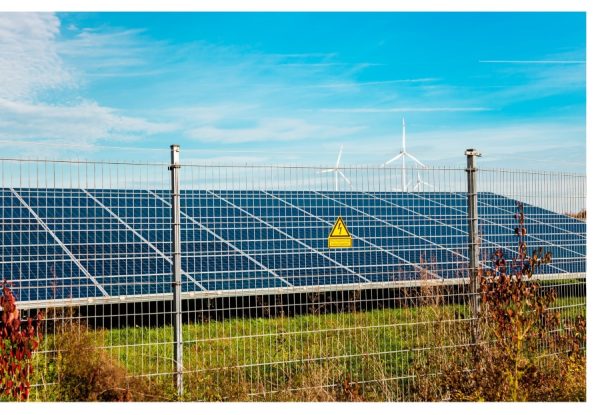
- Crash-Rated Bollards and Barriers: For sites with vehicle-access exposure, such as equipment rental yards, RV dealerships, and logistics depots, crash-rated barriers physically stop unauthorized entry. These systems are rated to withstand impacts from passenger or commercial vehicles and are critical for defending against both theft and targeted attacks.
- Remote Guarding and Private Patrol Integration: Remote guarding services combine intelligent detection with human verification. When a threat is detected via AI video analytics, fence alarms, or motion sensors, a trained operator verifies the intrusion and can issue a live audio warning or dispatch private patrol units. Companies like Stealth (acquired by Garda), Provigil, and Elite offer full-service models that reduce reliance on delayed or deprioritized police response.
- Audio Intervention and Live Voice-Down: Preemptive voice warnings issued through integrated speakers create immediate pressure on intruders and often stop a breach before it escalates. This tool is most effective when paired with real-time monitoring and intelligent perimeter detection systems.
- Strategic Lighting and Physical Design: Criminals thrive in the shadows. Perimeter lighting plans should eliminate blind zones, highlight potential access points, and support camera performance without creating glare. In combination with fencing and signage, lighting can reinforce that a site is protected, monitored, and prepared to respond.
Today’s perimeter solutions are evolving beyond surveillance into active prevention. Integrating physical barriers with live monitoring, private patrols, and automated deterrents delivers one outcome: fewer incidents, fewer losses, and more peace of mind.
Winter’s Quiet Threat to Perimeter Security
Winter brings more than cold, it shifts criminal behavior. While violent crime tends to rise in summer, property crime increases in winter. Lower visibility, earlier sunsets, and reduced foot traffic all create ideal conditions for theft and intrusion (source: Amarok, multiple including Norwood & Norwood).
Even in areas without snow, cold snaps can fog up cameras, reduce image clarity, and delay detection. 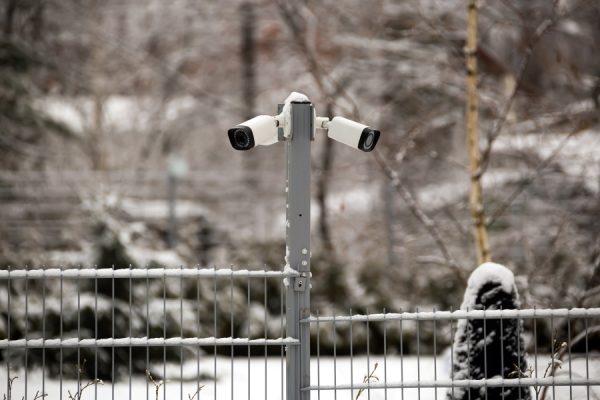
What changes, if any, would you have retailers make to their site’s perimeter defense to ensure continuity from December through March?
What Retailers Can Do to Prevent Outdoor Asset Theft
Retailers with outdoor inventory face a dual risk: high-dollar assets and low after-hours visibility. Yet, too many still rely on internal loss prevention programs to solve what is ultimately an external threat. Traditional approaches like surveillance footage and shoplifting deterrents won’t stop a perimeter breach in progress.
It’s time for retailers to elevate perimeter protection as a strategic priority. This means treating the edge of your property, not just the entrance to your store, as the first line of defense.
Outdoor asset crime is opportunistic, costly, and growing. Only a layered, proactive approach designed to detect, deter, and physically deny access can reduce losses, prevent disruption, and protect the bottom line.
Investing in perimeter strategy isn’t just about equipment. It’s about building smarter infrastructure, choosing partners who can verify and respond in real time, and designing a site that’s difficult to breach in the first place.
Because once an asset theft happens, the cost of recovery—if recovery even occurs—far outweighs the cost of prevention.

SPECIFIERS CORNER: VIRTUAL ROUNDTABLE
Beyond Barriers: Real-World Lessons in Public Safety Design
As threats to public safety become increasingly complex, the role of perimeter design has never been more critical or collaborative. Today’s specifiers must balance physical deterrence with community accessibility, integrate hardscaping with smart systems, and address risk and liability in ways that go far beyond traditional safety and security measures.
In this edition of Specifier’s Corner, SmartPerimeter.ai invited leading experts to weigh in on the evolving challenges and opportunities in perimeter protection. Drawing from real-world projects in cities like New Orleans and Liverpool, they share lessons learned, emerging trends, and practical advice for designing public spaces that are both secure and welcoming.
This roundtable features insights from:
- Rob Reiter, Co-Founder, Storefront Safety Council
- Sean A. Ahrens, CPP, CHPA, CSC, Syl, BSCP Security Market Group Leader, Affiliated Engineers, Inc. (AEI)
- Robert Miller, PSP, CDT, Independent Consultant and Subject Matter Expert in Fences, Gates, Bollards, and Barriers, Imperial PCS
Interviewed by Heather Martin, editor of smartPerimeter.ai, the discussion explores the intersection of design, safety, and technology in the context of protecting public space.
Public Safety: What Are the Most Pressing Challenges Today?
Design Lessons from the Field: Are there any recent projects that offer valuable design or implementation lessons for public safety?
Case in Point – Super Bowl 2025
 Just weeks before the 2025 Super Bowl, a vehicle attack on Bourbon Street in New Orleans left 14 people dead and dozens more injured. The city’s rapid shift from tragedy to hosting one of the nation’s largest events put DHS and CISA’s safety frameworks to the test. With proactive planning, inter-agency coordination, and well-executed perimeter strategies, New Orleans demonstrated that design, money and action can prevent further tragedy.
Risk, Liability, and Safety Planning: How do you approach the intersection of risk mitigation, liability protection, and urban safety in your perimeter designs?
Design Principle: Circulation Analysis
Mapping how people and vehicles move through a space should be a first step, not an afterthought. As Sean A. Ahrens notes, “This is where risk is either built in or eliminated.” By identifying circulation patterns early, specifiers can better safeguard access to high-risk areas while maintaining function and flow.
Technology Integration: How are you seeing public safety evolve in terms of integrating physical measures (e.g., bollards, barriers) with electronic systems or data?
What Is EFO?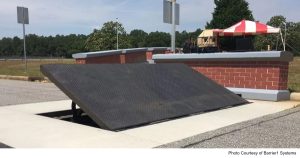
Emergency Fast Operation (EFO) is a feature in modern automated barriers allowing near-instant response to credible threats. When triggered—via sensors, AI analytics, or multiple input types—these systems can activate in less than a second, turning open circulation zones into fortified positions without disrupting normal access.
Image Source: Barrier1 Systems, https://barrier1.com/
Are There Any Recent or Ongoing Projects That Reflect Your Public Safety Focus?
Editor’s Note:
Due to the sensitive nature of their work, some respondents were unable to share details about current projects. However, each emphasized that their recent experiences continue to shape how they approach risk, design, and prevention in public safety environments.
Advice to Specifiers: What’s one mistake you see specifiers or planners Make When Designing For Public Safety, And How Can It Be Avoided?
Wrap-Up: The Human Cost of Overlooking Perimeter Design
Every sidewalk, storefront, and stadium holds the potential to be a place of safety—or a site of tragedy. Thoughtful perimeter planning isn’t optional. It’s a responsibility that can save lives. When we treat design seriously from the start, we move from reacting to harm to preventing it.
Thank you to our experts for offering their real-world insights.
-Heather Martin, Editor, smartPerimeter.ai


Fan Safety and Security
Creating a Safe and Secure Fan Journey in a New Era of AI-Enhanced Protection
At the Innovation Institute for Fan Experience (IIFX), we believe the fan journey begins long before fans arrive at a venue—and continues long after they leave. In today’s evolving threat environment, creating a safe and secure fan experience requires expanding our thinking beyond traditional venue walls that have traditionally formed our perimeters.
High-profile events, including concerts, games, festivals, marathons, and races are increasingly targeted by those who seek to disrupt public gatherings. As threats grow in sophistication, our approach must evolve. It’s not enough to rely on checkpoints or physical barriers. We must safeguard every touchpoint of the fan journey, blending human expertise with cutting-edge technology.

That’s why artificial intelligence (AI) is a game-changer in securing the perimeter. AI-powered systems, like those reported in smartPerimeter.ai, are revolutionizing how we secure venues and critical infrastructure. With real-time data analysis, behavioral pattern detection, and intelligent threat monitoring, AI enhances situational awareness and empowers venue operators and security teams to harden their critical infrastructure and act with speed and precision.
These AI-driven solutions help detect potential risks before they escalate—whether it’s a suspicious vehicle, an unauthorized drone, or a cyberattack targeting operational systems. AI also extends our digital perimeter, safeguarding critical data, communications, and operational networks that support live events.
Beyond the sports and entertainment sectors, transportation hubs—airports, seaports, and transit centers—face similar challenges. They, too, benefit from proactive AI-enhanced perimeter security, helping prevent incidents and protect the flow of people and commerce.
At IIFX, we champion these innovative solutions through our Fan Journey Best Practices Playbook, promoting integrated strategies that align human capital, technology, AI, and proven security protocols. Together with industry innovators like smartPerimeter.ai, we’re committed to empowering organizations to deliver seamless, safe, and secure experiences that build trust and confidence among fans and communities.
Our mission is clear: to protect lives, enhance the fan experience, and build a culture of continuous improvement in the sports and entertainment industry.
By Dr. Lou Marciani, Director and Co-Founder, Innovation Institute for Fan Experience (IIFX)

ABOUT: The Innovation Institute for Fan Experience (IIFX) is a global organization that helps sports and entertainment venues create safer, more enjoyable fan experiences through expert guidance, training, and best practices. Founded in 2020, it brings together leaders in safety, security, and operations from around the world.
References:
Innovation Institute for Fan Experience. (2025). About IIFX. Retrieved July 19, 2025, from https://www.iifx.org
SmartPerimeter.ai. (2025). Smart perimeter security solutions. Retrieved July 19, 2025, from https://smartperimeter.ai
vFairs. (2025). IIFX Best Fan Journey Practices Virtual Conference 2025. Retrieved July 19, 2025, from https://fancentric.vfairs.com/en/
FEATURED CONTENT
The Reseller Channel: Does Perimeter Security Have One?
The physical security market is largely distribution-based. More than 90% of products are sold through a “box cost plus” model—where, for example, a security camera is priced based on purchase quantity, then marked up by the reseller or systems integrator. Software licenses for video management or access control are typically purchased through a reseller’s master service agreement (MSA).
Yet many companies in the security channel remain hesitant to address perimeter risk for their customers. As a result, perimeter safety and security solutions are often sold directly to enterprise or end-user buyers, bypassing the channel altogether.
But today’s perimeter isn’t just fences and gates. It’s the front line of risk, where crime, loss, and business disruption begin. This has elevated perimeter protection into a $95 billion global market, with $18 billion in the U.S. alone.
Two key realities now intersect:
- The market is too large for manufacturers to rely on direct sales alone.
- It’s too important for integrators and resellers to ignore. Customers increasingly demand holistic risk management strategies—and the business opportunity is substantial.
Yes, there are still fences and gates. But now they’re enhanced with superhuman sensors, intelligent lighting, AI-powered analytics, and reliable high-speed networks. The backend is evolving rapidly, with AI reducing nuisance alarms in real-time.
Translation: it’s RMR (recurring monthly revenue) growth time—the incentive for integrators to get in the game.
Here’s how perimeter-focused manufacturers are building momentum across the channel, working through specifiers, architect firms, system integrators, and reseller networks:
Distribution Trends & Strategy Highlights
- Shift Toward Service-Centric Distributor Roles
- Distributors now deliver staging, logistics, and training, pushing manufacturers to offer total ecosystem support.
- Convergence of Security + Technology
- Intelligent analytics, AI-driven detection, and drone/fence intrusion alerts drive demand for integrators who can mesh cameras, sensors, and software securely.
- Early Inclusion Via Architects
- Manufacturer success increasingly depends on writing the product into specs rather than chasing retrofit business.
Leading System Integrators for Perimeter Safety & Security
Based in Columbus, Ohio, manages security for a wide range of clients from ports to data centers to salvage yards. In every case, risk and security start at the perimeter to ensure stakeholder safety and asset protection.
Based in Wasilla, Alaska, specializes in perimeter protection and delivers holistic, in-depth risk assessments and custom security solutions. This full-service integrator brings family values to every project: honesty, integrity, trust, and reliability.
Based in Norcross, Ga., offers traditional solutions including fencing, gates, and barriers. They are working with manufacturer partners to integrate advanced technologies into perimeter solutions such as Axis Communications and SightLogix for data center perimeter security.
Sun Valley, Calif., serves the greater Los Angeles area, specializing in installing, monitoring, and supporting state-of-the-art cloud-based video, access, and intrusion systems to ensure around-the-clock safety.
Based in Kent, Ohio, protects people, facilities, and brand reputation by advancing intelligent, integrated security solutions. Its Sage Fence subsidiary was created to address customers’ perimeter security needs.
Based in Albuquerque, NM, continues to expand its perimeter security business with new technologies and best practices by creating tailored security solutions that stop property intrusion and outdoor crime.
Bottom Line: Straight Talk
| Channel | Manufacturing Strategy | Risk |
|---|---|---|
| Architect/Specifier | Embed CAD/specs, CEUs, code compliance | Miss early inclusion = lost deals |
| System Integrator | Certification, staging labs, co-marketing | Weak support → Integrators pick competitors |
| Reseller/VAR | E-commerce enablement, demo gear, incentives | No stocking → slow turnaround loses SMB market |
The perimeter security space is no longer just about bolts and sensors. It’s about ecosystems—embedded early in designs, delivered by tech-savvy integrators, and supported by service-focused resellers. Standalone, product-first tactics no longer suffice, especially as budgets tighten and buyers demand full turnkey resilience.
This is a straightforward look at how perimeter security manufacturers are navigating the three key distribution channels and the tactical moves they’re using to win them.
Architect & Specifier Channel
Key Strategies:
Pre‑Spec Collaboration: Manufacturers like Honeywell and Honeywell Pro‑Watch furnish spec-ready CAD drawings, compliance documentation (e.g., FIPS, UL), and “CSI‑format” guides—making it easier for spec firms to embed their solutions early.
CEUs & Accredited Training: Through Security Industry Association (SIA) and local A&E events, vendors host CEU courses targeting architects and specifiers, building familiarity and product loyalty.
Why It Matters:
Designing products into specs upfront virtually locks integrators and resellers out of retrofit competition, ensuring first‑mover advantage.
System Integrators (SI) & Security Consultants
Power Shift: System Integrators are doubling as design and deployment partners, not just installers. Integrators are taking up the lion’s share of multi-tech perimeter projects.
Manufacturer Tactics:
Tiered SI Programs: Axis, Senstar, and others offer SI partners specialty certification, demo kits, staging labs, joint marketing campaigns, and priority warranty support. (Wikipedia)
Integrated Case Studies: Axis & SightLogix + Convergint showcase integrated solutions for data center perimeters, highlighting manufacturer/SI synergy. (Convergint)
Value-Add Distros: Distributors are expanding beyond logistics into design assistance, onsite staging, and turnkey solution delivery.
Why It Matters:
Integrated perimeter systems require SI expertise. Vendors that neglect SI support are bypassed in favor of certified SI-aligned brands.
Resellers & VARs
Focus Area: Resellers serve mid-market, SMB, and light-security verticals where speed and simplicity matter most.
Manufacturer Tactics:
Online Tools & E‑commerce Enablement: Vendors equip resellers with web-based configuration tools, real-time quoting engines, and drop-shipping arrangements.
Demo Stock & Incentives: Offering stocked demo hardware, demo support, and co‑branded campaigns to elevate reseller offerings.
Why It Matters:
Quick-turn, low-margin deals depend on reseller responsiveness. Vendors relying on long lead times or absent stock get sidelined by agile, digital-savvy competitors.
Emerging Themes Across Channels
- From Product to Ecosystem: Buyers demand full-stack solutions, not just cameras or fences. These require orchestration across sensors, analytics, AI, and access control. Manufacturers align with SIs to deliver unified ecosystems.
- Front-End Intelligence & Analytics: Vendors like SightLogix and Senstar focus on early intrusion detection (e.g., thermal, forensics) integrated at the sensor edge to reduce false alarms and accelerate response.
- Services at the Core: Distributors and integrators increasingly offer design-build staging services. Manufacturers reinforce this with training, integration support, and SLAs.
- Earns Trust Through High-Stakes Case Studies: Brand strategies center on public case studies in high-profile verticals such as data centers, utilities, and transport hubs to win both specifiers and integrators. Examples include Convergint + SightLogix data centers and Ameristar’s anti-ram barriers in co-location centers (arxiv.org, Convergint).
Vendor Spotlights & Leadership
- Senstar (Fabien Haubert, CEO; Jeremy Weese, CTO): Leading in fence-mounted sensors + intelligent lighting/sensors hybrid units. (Wikipedia)
- Axis Communications: Open-platform surveillance + access hardware, powering deep SI and specifier engagement. (Axis Communications)
- SightLogix (with integrator Convergint): Deploying thermal analytics in mission-critical perimeters and showcasing edge-based systems with low false alarms. (Convergint)
- Ameristar: Specializing in vehicular crash-rated barriers integrated into existing security systems, selling through integrator design routes. (Ameristar)
- Axis, Honeywell, Bosch, Siemens: Market leaders investing in spec-direct documentation and SI certification, pushing early ecosystem inclusion.
Tactical Takeaways
| Channel | Do This | Avoid |
|---|---|---|
| Architect/Specifier | Invest in CAD drawings, spec guides, CEUs | Waiting until the installation stage |
| SI Channel | Build robust partner programs, demo support, and joint case studies | Neglect tiered support and SI branding |
| Reseller/VAR | Equip with e-commerce tools, demo kits, promo bundles | Rely solely on price or lead times |
Architect & Specifier Influence on Enterprise Buyers
Governed by Standards-Based Procurement: Large organizations (GSA, universities, utilities) require compliance with building standards (e.g., GSA P100) and expect pre-approved CAD designs, test reports, and UL/FIPS compliance for perimeter solutions (SourceSecurity, U.S. General Services Administration).
Security-By-Design: Architects select integrated systems during design, writing them into specs. This locks out retrofit-only products and guides enterprise-wide deployments across all facilities.
Consulting-led: A&E firms collaborate with end-user facilities and security teams to identify perimeter needs (fence sensors, bollards, thermal cameras, AI analytics) layered into RFPs from day one.
System Integrators & Consultants as Procurement Gatekeepers
SIs as Strategic Partners: Enterprises rely on trusted integrators (e.g., Convergint, Ameristar) to architect, configure, and manage systems end-to-end, leveraging integrators over resellers for complex, multi-site projects.
Distributors as Value-Add Enablers: Integrators depend on distributors for staging, logistics, inventories, and designing with emerging tech (AI, cloud, IoT). (Security Info Watch).
Cloud & Managed Services Adoption: Leading enterprises are shifting to SaaS/multi-site access control and perimeter monitoring (e.g., Brivo, Kastle) through their integrators, moving from capital expense to operational expense models. (Security Industry Association)
Resellers & VARs in the Enterprise Mix
Target Mid-Tier and Decentralized Purchasing: While large projects go through specs and integrators, resellers handle fast-turn perimeter upgrades for branch offices, remote sites, and campuses.
Digital and Demo-Led Selling: Manufacturers empower resellers with online quoting tools, component stocking, demo units, and bundled solutions (e.g., fences + sensors + cameras).
Swipe-Right Simplicity: Enterprises with distributed sites often favor resellers for their speed and convenience versus the overhead of large integrators.
Buying Patterns: Enterprise End Users
- RFP = Specified Solutions
- Defines architecture: physical barrier + electronic detection + analytics/cloud.
- Delivered directly through SI or A&E spec teams.
Buying Patterns: Enterprise End Users
2. Ongoing Operations (OpEx over CapEx)
-
- Move from CapEx to operations & maintenance (O&M) via managed/cloud service models for unified perimeter and building security.
Why This Matters for Manufacturers
To achieve growth multipliers, manufacturers need to motivate a reluctant channel to address outside risk and security from the front door to the property line. There is a lot of selling needed to convince system integrators that they will get robust partner support and significant monetary upside. System integrators should recognize the competitive risk of leaving perimeter security off the table, especially when doing so may push their customers toward vendors who offer more complete, turnkey safety solutions.
How manufacturers can gain channel momentum:
- Win With Specs First: Investing in certified CAD support and design partnership secures enterprise-wide rollouts.
- Support SI Ecosystem: Offer integrator training, lab kits, cybersecurity compliance, and staged tech demos via distribution partners.
- Fuel Pilots and Roll-Outs: Support trial programs like pilot deployment backed by analytics and managed service models.
- Empower Mid-Tier Reach: Equip resellers with e‑commerce tools, stock solutions, and simplicity to fast-track site-level buys.
Summary View
| Channel | Enterprise Role | Why It Works |
|---|---|---|
| Architect/Specifier | Embed perimeter systems in building planning | Ensures enterprise-wide standardization |
| System Integrator | Design, implement, and operate multi-site systems | Handles complexity, compliance, lifecycle |
| Reseller/VAR | Rapid upgrades at the site level | Offers speed, convenience, turnkey kits |
Autonomous Perimeter Defense: How Robots and Drones are Rewriting the Rules of Outdoor Security
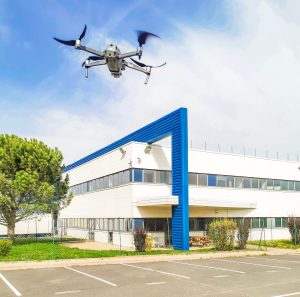 The perimeter is no longer a fixed line—it’s a dynamic battleground patrolled by autonomous robots, monitored from the skies, and challenged by airborne threats. As organizations integrate mobile technologies with traditional fences, sensors, and cameras, they’re rethinking how to protect critical outdoor spaces.
On one hand, ground-based robots and aerial drones are enhancing detection, response, and coverage. On the other, drones are being used for espionage, smuggling, political messaging, and potential acts of terrorism. Whether it’s a hobbyist’s toy or a deliberate breach, the inability to defend against airborne intrusions has become a growing operational risk.
This double-edged frontier, where autonomous defense meets autonomous threat, is rapidly transforming the perimeter security landscape.
The Challenge: A Perimeter Isn’t Just a Fence Anymore
Traditional perimeter security was built on a simple premise: allow authorized people and vehicles in, and keep everyone else out. Easy enough, until the threats stopped using the front gate.
Today, intrusions fly over walls, piggyback through authorized entries, or exploit blind spots in the system. These aren’t hypothetical scenarios, they’re already happening:
- Data centers face espionage from drones capturing sensitive Wi-Fi signals or filming through windows.
- Correctional facilities deal with drone drop-offs of contraband, including phones, tools, and drugs.
- Stadiums are vulnerable during live events where a drone can cause a delay at best, or a mass panic at worst. Yet under FAA regulations, most venues are defenseless against midair threats.
- Utilities and solar farms require patrols across vast areas—something human guards can’t scale efficiently. Autonomous drones offer wide-area coverage, real-time awareness, and cost-effective deterrence.
The Rise of Ground Robots: Security That Doesn’t Sleep
Ground-based security robots from companies like Asylon, Knightscope, RAD, and Boston Dynamics are now actively patrolling military bases, logistics hubs, and corporate campuses. These autonomous systems offer 24/7 coverage, AI-driven analytics, and a visible deterrent, without the limits of human fatigue.
Case Study: Asylon DroneDog Patrols for Logistics Yards
Built on the Boston Dynamics Spot platform, Asylon’s DroneDog is being deployed by Fortune 100 logistics companies to autonomously patrol outdoor yards, capture footage, and respond to motion alarms. Integrated with Asylon’s Robotic Security Operations Center (RSOC), the robot can stream live video, engage remotely using lights and audio, and enhance situational awareness in real time.
Specs:
- Range: Up to 3 miles per mission
- Patrol Duration: 90 minutes
- Payload: Cameras, infrared, 2-way communication
Use cases include:
- Overnight patrols at distribution centers
- Deterring theft or unauthorized entry
- Compliance with union restrictions on manned patrol zones
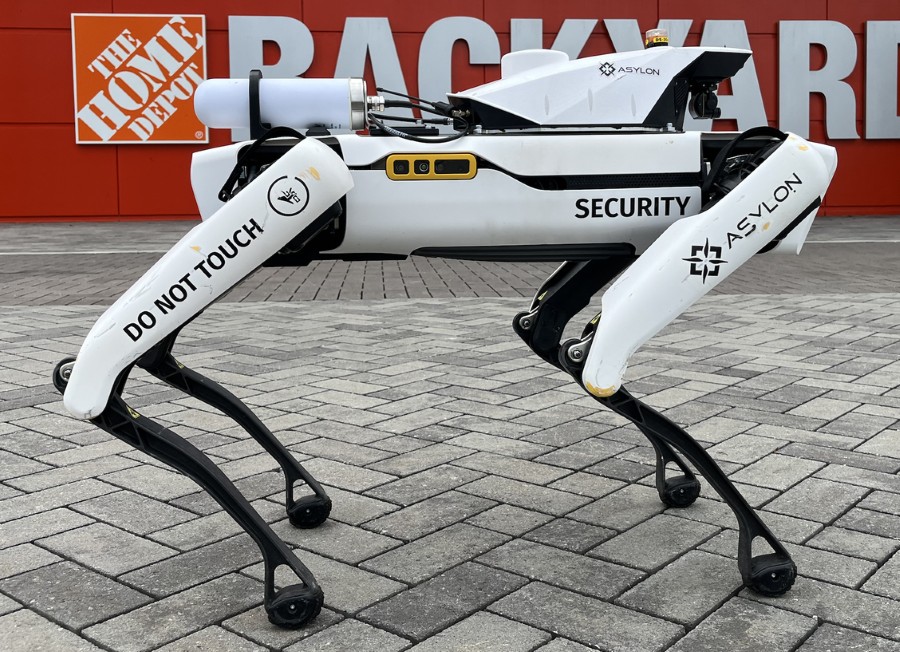
Image Source: Asylon Robotics, https://asylonrobotics.com/
Knightscope K5: Autonomous Security at Scale
Knightscope’s K5 robot patrols outdoor plazas, hospital grounds, and retail parking lots—capturing license plate data and detecting anomalies through onboard AI. It offers:
- 24/7 autonomous surveillance
- Advanced AI & real-time threat detection
- Fully autonomous patrolling
- Physical presence and deterrence
- Remote monitoring and control
- Data-driven insights and reporting
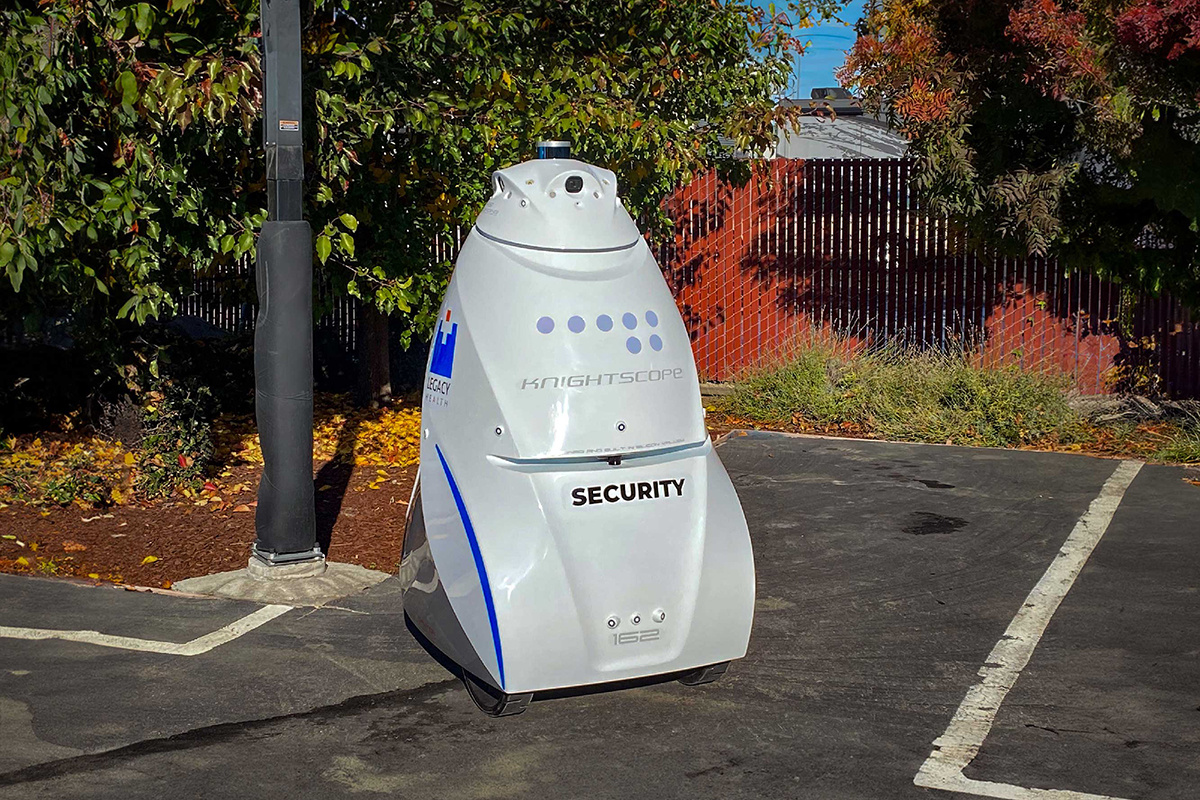
Image Source: Knightscope, https://knightscope.com/
RAD ROAMEO Gen 4: Presence Meets Intelligence
At 6’8″, the ROAMEO Generation 4 robot from Robotic Assistance Devices (RAD) is engineered for high-visibility environments like corporate campuses, industrial facilities, and public parking structures. Equipped with lidar, radar, and advanced visual sensors, ROAMEO combines physical presence with:
- Fully autonomous navigation
- Advanced obstacle detection
- Real-time situational awareness
- AI-powered threat detection
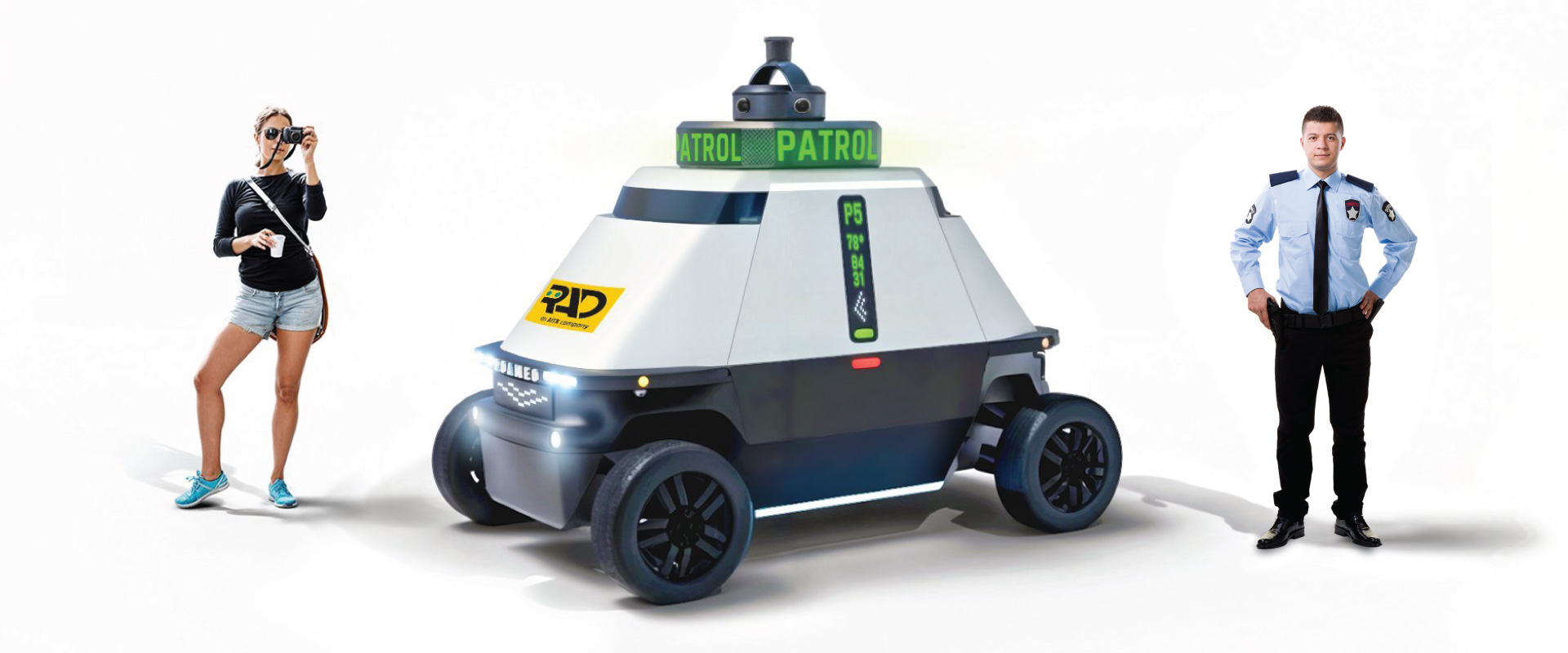
Image Source: Robotic Assistance Devices (RAD), https://radsecurity.com/roameo/
Aerial Drones: Eyes in the Sky, Rapid Response
Aerial security drones deliver unmatched mobility and real-time threat detection, especially across large, remote, or hard-to-reach environments. These airborne systems expand perimeter visibility and enable faster response times than ground patrols alone.
LandSkyAI’s SkyGuard
Is purpose-built for rapid deployment and autonomous perimeter defense. The system provides consistent patrols and can instantly respond to triggered alerts.
SkyGuard Tethered
Enables continuous 24-hour surveillance from a fixed vantage point. Designed for simplicity, this push-button system allows teams to launch, monitor, and land drones effortlessly, boosting situational awareness while minimizing manpower and operational costs.
Example: SkyGuard for Critical Infrastructure
SkyGuard is increasingly used to protect electric grids and substations, offering wide-area oversight and proactive threat detection across sensitive sites. Key use cases include:
- Perimeter Fencing & Entry Points: Detecting unauthorized access or physical damage
- Transmission Lines & Towers: Conducting routine aerial inspections for structural integrity and potential threats.
- Transformers & Switchgear: Detecting overheating, leaks, or anomalies that may indicate security risks or equipment failure.
- Backup Power Systems & Generators: Ensuring critical backup systems remain operational and secure.
- Control Centers & Communication Hubs: Providing additional surveillance for high-risk facilities housing grid operation controls.
- Fuel Storage & Substation Yards: Monitoring for theft, tampering, or environmental hazards.
Drone Threats: When the Intruder Is Also Autonomous
As organizations adopt drones for perimeter defense, they must also prepare to defend against drones used for intrusion, smuggling, surveillance, and even attacks.
Real-World Threats:
- In 2023, drones were used to map and exploit blind spots in a corporate data center’s perimeter in Texas.
- Correctional institutions in Georgia and California have reported drone drops of cellphones, narcotics, and weapons.
- In 2018, a drone laden with explosives targeted Venezuelan President Nicolás Maduro at a public event, highlighting the national security stakes.
The Counter-UAV Response: Detect, Classify, Defeat
Defending against drone intrusions requires a layered approach:
- Detection: Using radar, RF scanners, or acoustic sensors to identify UAV presence.
- Classification: AI-based systems differentiate between birds, drones, or other aerial activity.
- Defeat: Response tactics include RF jamming, GPS spoofing, or net-based physical capture.
The Takeaway: Intelligent Perimeters Must Be Mobile and Defensible
Today’s perimeter isn’t just a fence. It’s a fluid, intelligent zone requiring both mobility and resilience. Autonomous ground robots and aerial drones are redefining how perimeters are patrolled. At the same time, counter-drone systems ensure these spaces remain protected from above.
YOU’RE INVITED!

Join us at the IIFX Best Fan Journey Practices Virtual Conference, October 28–30, 2025. This global event brings together leaders, practitioners, and innovators to share insights, strategies, and solutions for delivering exceptionally safe and secure fan experiences.
Early Bird Registration (now – October 1) is just $39 per person, which includes full access to all best practice sessions and a digital copy of the 2025 IIFX Best Fan Journey Practices Playbook featuring industry-recommended practices across:
- Access & Credentialing
- Communications
- Crowd Dynamics
- Event Entertainment
- Safety and Security
- Pre-Event and Game Activities
- Sustainability and Sustainable Operations
- Transportation & Parking
- Technology & AI
- Wayfinding Aids
- Facility Infrastructure
- Food & Beverage
- Guest Services & Fan Experience
- Human Capital
- Perimeters
Register today at: https://fancentric.vfairs.com/en/
Let’s protect and elevate the fan experience—together.
INDUSTRY NEWS
AID2entry and SIAThere Chicago Present “Security Professionals Day”
Live and In-Person at the Grand Opening of The Security Innovation Hub

Chicago, IL – July 31, 2025 – The Security Innovation Hub is proud to announce the grand opening of its new state-of-the-art facility with a dynamic live event: Security Professionals Day, co-hosted by AID2entry and SIAThere Chicago. This in-person gathering will bring together physical and cyber security professionals to explore cutting-edge identity and access solutions shaping the future of security.
Who Should Attend:
Security professionals from businesses of all sizes across Illinois and neighboring states—whether focused on physical security, cybersecurity, or IT infrastructure—are encouraged to attend.
What to Expect:
Attendees will network with industry peers, hear from expert speakers, and gain practical insights into managing access control, onboarding, compliance, data privacy, and identity verification in today’s evolving workplace. A special focus will be placed on the latest AID2entry technologies for physical (e.g., access control, time and attendance) and digital identity management.
Where:
The Security Innovation Hub
1302 South Kilbourn Ave
Chicago, IL 60623
When:
Thursday, September 18, 2025
Why Attend:
This FREE event offers a unique opportunity to stay ahead of the curve. Discover how mobile credentials, AI, and integrated identity platforms are redefining access—both online and on-site. Join the conversation on the broader societal and economic impact of these technologies.
How to Register:
Request your invite and learn more at www.AID2entry.com.
Media Contact:
Doug OGorden
doug@gettothepointmedia.com
224-504-9351